




Download Notes & Worksheets 📌
| Download Notes | Click here |
| Download Worksheet | Click here |
Blood relation forms an important part of the reasoning section in most of the competitive exams. Blood relation shows the different relations among the members of a family. Based on the information given, you are required to find the relation between particular members of the family. Scoring marks in this topic is easier as compared to many other topics in the reasoning section. So, you must be well versed with types of relations that exist in a family.
Blood relation reasoning involves in reaching the conclusion by applying the rules of relationships within a family structure, often through direct or coded questions, and mastering it requires understanding familial connections and practicing logical deductions
Understanding Blood Relation Concepts
Step 1: The first and foremost step is to choose the two persons among whom the relationship is to be established.
Step 2: Now once you have chosen the two persons, pin-point the intermediate relationship between two persons, i.e. such relationship through which long drawn relationship can be established between the required persons.
Step 3: In the end, conclude the relationship between two required persons.
Parental Relations :
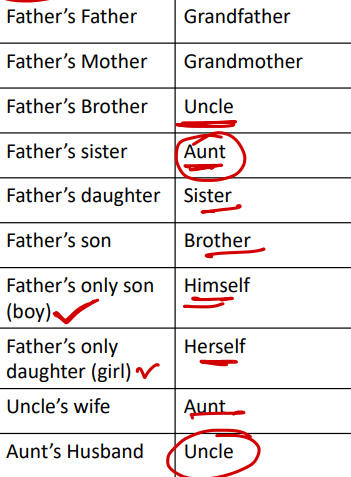 | 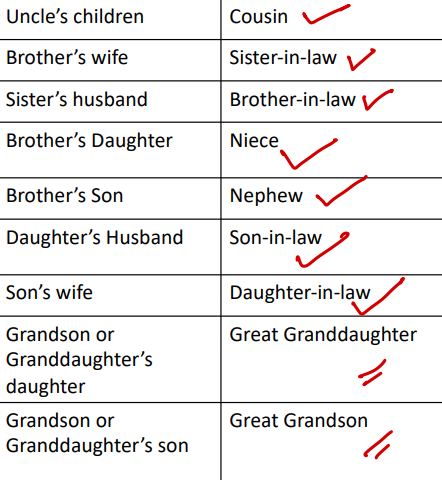 |
MATERNAL SIDE RELATIONS :
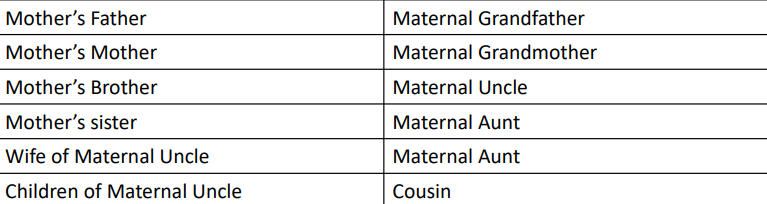
Common Types of Blood Relation Questions
1. Pointing or Introducing
In these questions, individuals are introduced or described using their relationships to others. The goal is to identify the relationship between the individuals mentioned.
Example: A woman introduces a man as her “father’s brother’s son.” How is the man related to the woman’s father?
2.Family Tree
These questions provide a diagram of a family tree, and you’re asked to determine relationships based on the given information.
Example: In a family tree, A is the father of B, B is the sister of C, and C is the mother of D. What is the relationship between A and D?
3.Coded Relations
In these questions, relationships are represented by codes, and you’re given a set of rules or equations to decipher the codes.
Example: In a coded blood relation system, M represents Mother, F represents Father, S represents Son, and D represents Daughter. Translate the code MFS: FMSD.
4. Mixed Blood Relations
These questions involve a combination of the above types, often mixing pointing, family tree, and coded relations.
Example: A man points to a woman in a photograph and says, “Her mother’s brother is my mother’s father’s only son.” How is the girl’s mother related to the man?
5. Puzzle-Based Blood Relation
These questions present a puzzle or scenario involving blood relations and require you to solve the puzzle using logical reasoning.
Example: In a family of six, there are three generations. The grandfather has two sons and one daughter. Each son has two children, and the daughter has one child. How many grandchildren does the grandfather have?
6.Single-Person Blood Relation
These questions focus on determining the relationship between a single individual and another person based on the given information.
Example: A woman says, “My brother’s son’s sister is my niece.” What is the relationship between the woman and her niece?
Common Types of Blood Relation Questions
Question 1: Pointing to a girl in the photograph, Ajay said, “Her mother’s brother is the only son of my mother’s father.” How is the girl’s mother related to Ajay ?
A) Mother
B) Sister
C) Aunt
D) Grandmother
E) None of these
Solution:
Only son of Ajay’s mother’s father — Ajay’s maternal uncle.
So, the girl’s maternal uncle is Ajay’s maternal uncle.
Thus, the girl’s mother is Ajay’s aunt.
Questions 2 : A woman introduces a man as the son of the brother of her mother. How is the man related to the woman ?
(a) Brother
(b) Uncle
(c) Nephew
(d) Cousin
Answer: (c) Nephew
Explanation : The woman’s mother is the man’s grandmother. The man’s father is the woman’s uncle. Therefore, the man is the woman’s nephew.
Questions 3 : If A is the brother of B; B is the sister of C; and C is the father of D, how D is related to A ?
A) Brother
B) Sister
C) Nephew
D) Cannot be determined
Correct Answer : D)
If D is Male, the answer is Nephew.
If D is Female, the answer is Niece.
As the sex of D is not known, hence, the relation between D and A cannot be determined.
Note: Niece – A daughter of one’s brother or sister, or of one’s brother-in-law or sister-in-law. Nephew – A son of one’s brother or sister, or of one’s brother-in-law or sister-in-law.
Questions 4 : A is the son of C; C and Q are sisters; Z is the mother of Q and P is the son of Z. Which of the following statements is true?
A) P and A are cousins
B) P is the maternal uncle of A
C) Q is the maternal grandfather of A
D) C and P are sisters
Correct Answer : (B)
C and Q are sisters and A is the son of C. Hence, C is the mother of A or Z is the mother Q.
Hence, Z is the maternal grandmother of A. P is the son of Z. Hence, P is the maternal uncle of A.
Question 5 : Pointing towards a girl, Abhisek says, “This girl is the daughter of only a child of my father.” What is the relation of Abhisek’s wife to that girl?
A. Daughter
B. Mother
C. Aunt
D. Sister
Correct option : B
Only the child of my father means ‘Abhisek’ himself. This means the girl is the daughter od Abhisek. Hence, Abhisek’s wife is the mother of the girl.